
The Foam process in seat manufacturing refers to the stage in which polyurethane foam or similar materials are applied to the seat structure in order to provide comfort, ergonomics, and support.
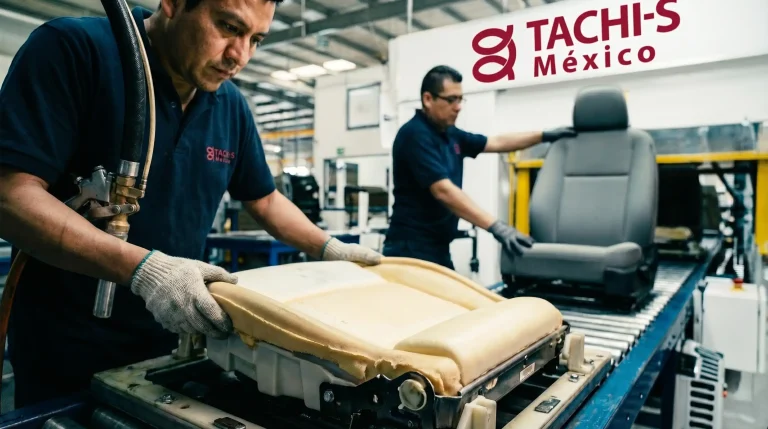
During the FOAM process at Tachi-S, polyurethane foam is applied using controlled injection and expansion systems. This process makes it possible to obtain components with the precise shape, density, and firmness required to ensure comfort, durability, and optimal seat performance throughout its entire service life.

The FOAM process consists of injecting liquid foam into specific molds, where it expands in a controlled manner and then goes through a curing period. This method allows the foam to be molded with precision, adapting it to the seat’s geometry.
The result is an ergonomic component that combines softness, support, and resistance, designed to enhance the driving experience and passenger comfort.
Structures manufactured with high-strength materials that ensure reliable long-term performance.
Design and assembly processes focused on meeting the safety standards required by the automotive industry.
Controlled processes that guarantee accuracy in every component manufactured.
Process standardization that ensures uniformity and reliability in every frame produced.
In this method, liquid polyurethane foam is injected into a mold or seat structure. The foam expands and solidifies within the mold, creating a specific shape and density.
In this process, polyurethane foam is placed into a mold with the desired shape, where pressure and heat are applied to form the seat cushion accurately.
At Tachi-S, additional features can be incorporated during the foam stage, such as integrated heating or ventilation systems within the seat cushion.

FRAME

FOAM

ASSY

CUT

SEW

MECHANISM

LAMINATION